
Event-Driven Architecture (EDA): A Practical Guide for Tech Leaders
Most systems don’t struggle because of scale. They struggle because change spreads too easily. A small update in one place forces changes everywhere else. Over time, systems become fragile, slow, and hard to evolve. Event-Driven Architecture (EDA) is one way teams try to fix that problem. Not as a trend—but as a different way to design how systems talk to each other. This guide explains EDA in plain architectural terms, so you can decide when it fits—and when it doesn’t.
12/19/20252 min read
What Is Event-Driven Architecture — Explained Simply
Event-Driven Architecture is about reacting to facts, not making requests.
An event is something that already happened.
Examples:
An order was placed
A payment was completed
A customer profile changed
An event does not ask another system to do something.
It simply announces that something occurred.
Other systems can choose to react—or ignore it.
Events vs Requests: The Core Shift
Traditional systems are request-driven.
One system:
Calls another system
Waits for a response
Knows exactly who it depends on
This creates tight coupling.
Event-driven systems work differently.
A system:
Publishes an event
Does not wait
Does not know who consumes it
That single shift changes how systems grow and evolve.
Core Building Blocks of Event-Driven Architecture
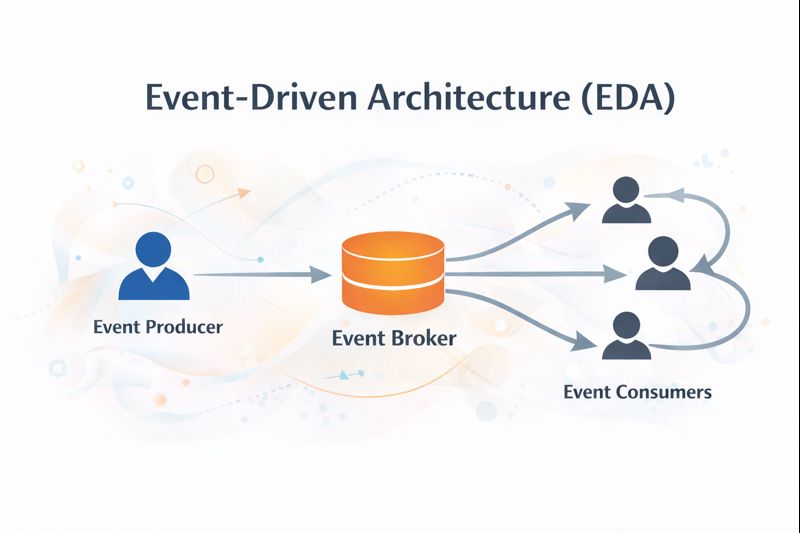
Most EDA setups include three simple roles.
Event Producer
A system that publishes events when something changes.
Event Broker
A shared channel that receives events and makes them available.
Event Consumer
One or more systems that react to events in their own way.
The producer never talks directly to consumers.
That separation is the key benefit of EDA.
How Event-Driven Architecture Works in Practice
A typical flow looks like this:
A business action happens
An event is published
The broker distributes the event
Multiple consumers react independently
Each consumer moves at its own pace.
If one fails, others continue.
This is very different from chained service calls.
Publish–Subscribe: Why It Matters
In publish–subscribe:
Producers publish once
Consumers subscribe to what they care about
New consumers can be added without changing producers
This is powerful in large systems where many teams depend on the same business signals.
Event Choreography vs Orchestration
There are two common styles.
Choreography
Each service reacts to events and may publish new ones.
No central controller decides the flow.
Orchestration
A central component controls the sequence of actions.
EDA naturally leans toward choreography.
But many real systems mix both approaches.
When Event-Driven Architecture Makes Sense
EDA works best in specific situations.
High Change Environments
If business rules change often, loose coupling reduces rework.
Many Downstream Consumers
When multiple systems need to react to the same change, events prevent point-to-point chaos.
Integration-Heavy Enterprises
Events create a cleaner way to share state changes across systems.
Typical examples include:
Order lifecycle updates
Notifications and alerts
Inventory or fulfillment changes
Audit and activity tracking
When EDA Is the Wrong Choice
EDA is not free.
Operational Complexity
Async systems are harder to reason about than simple request flows.
Debugging and Observability
Tracing a business flow across events requires strong tooling and discipline.
Team Readiness
EDA works best when teams are comfortable with:
Asynchronous thinking
Clear event design
Accepting delayed consistency where needed
Without this maturity, EDA can slow teams down.
EDA vs Traditional Architectures
Request–Response Systems
Simple to understand
Easy to debug
Tightly coupled
Event-Driven Systems
Flexible
Scalable
Loosely coupled
Neither approach is “better” by default.
EDA and Microservices: Clearing the Confusion
EDA does not require microservices.
Microservices do not require EDA.
They often work well together, but they solve different problems.
Many successful systems use a hybrid model:
APIs for direct queries and commands
Events for state changes and reactions
This balance keeps systems practical.
Key Design Questions Tech Leaders Should Ask
What Is the Event?
An event should describe what happened, not what should happen next.
Who Owns the Data?
Events share facts, not databases.
Each consumer owns its own data and decisions.
How Do Failures Recover?
Events should be re-playable.
This supports recovery, debugging, and future use cases.
How Are Events Governed?
Event changes affect many consumers.
Versioning and backward compatibility matter.
How to Start with EDA (Without Overengineering)
Start small.
Pick one meaningful business event
Add one consumer
Observe system behavior
Improve visibility and error handling
Keep APIs where they make sense.
Introduce events only where decoupling adds real value.
Final Thoughts: EDA Is a Choice, Not a Trend
Event-Driven Architecture is not about being modern.
It is about designing for change.
Used well, it helps systems evolve without breaking each other.
Used blindly, it adds complexity without benefit.
The real question is simple:
Should this interaction be a request—or an event?